
Knowing the blood type of your beloved cat is very important. Apart from recording if a blood transfusion is needed, knowing your blood type is also important for preparing for cat breeding.
HISTORY OF THE DISCOVERY OF BLOOD TYPES IN CATS
Cat blood groups have been studied since the early 20th century. Ingebrigtsen, in 1912, used Epstein and Ottenberg's technique to look for agglutination of blood cells and serum from different cats. He identified strong agglutinations in one or two cases but concluded that they did not define the blood group. The examination was repeated in 1915, but again did not identify a blood group system, although this study reported the first cat transfusion reaction. It wasn't until 1950 that two blood types were published. Two years later, Holmes postulated that cats could have three types of blood; However, this was not confirmed until 1981. The nomenclature of blood groups A and B was first defined by Eyquem, Podliachouk and Millot in 1962 (Barfield and Adamantos, 2011).
CATS BLOOD GROUPING
Blood group is a classification made on the basis of species-specific antigens on the surface of erythrocytes. Antigens associated with platelets, leukocytes, and plasma proteins may also be important in inducing immune-mediated reactions in animals during transfusion therapy. Naturally occurring alloantibodies against other blood groups can be present in animal plasma despite lack of previous exposure to those erythrocyte antigens (Thrall et al., 2012)
Antibodies to erythrocyte antigens are induced in response to exposure, either through blood transfusion, transplacental exposure or, in the case of neonatal isoerythrolysis, through colostrum (Thrall et al., 2012). The most important blood group system in cats is the AB system with blood groups A, B, and AB which are biochemically unrelated to the human AB0 system. Recently, another erythrocyte antigen has been described in Domestic shorthair cats, called Mic antigen (Khon and Weingart, 2006).
Type A blood type is the most common and is estimated to occur in more than 95% of Domestic shorthair (DSH) and Domestic longhair (DLH) cats in the United States. Type B occurs with varying frequency (<5–25%) in Abyssinian, Birman, Himalayan, Scottish fold, Somali, Sphinx, Maine coon, Norwegian forest, and Persian, while the highest frequency (25–50%) has been reported in British shorthair, Cornish Rex, Devon Rex, and Turkish Van. A higher percentage of DSH/DLH cats in the West Coast regions of the United States, Europe, Japan, India, Turkey, and Australia are reported to be type B; a recent report found up to 30% of DSH/DLH cats were type B in the UK (Thrall et al., 2012).
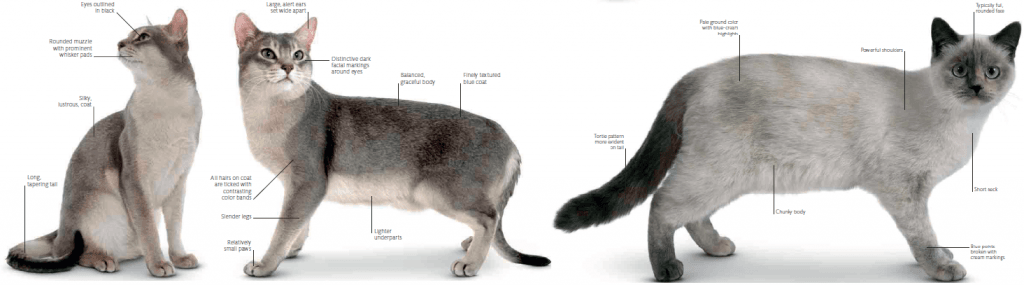
Abyssinian cat (Left) and Bristish shorthair (Right) (Complete and Breed, 2014).
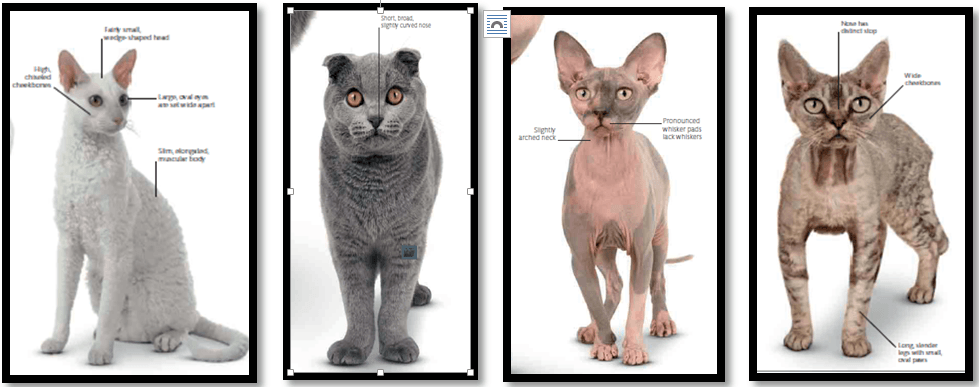
Cats Cornish Rex, Scottish fold, Sphinx, Devon Rex (left to right) (Complete and Breed, 2014).
Blood type AB is very rare, but has been reported in DSH / DLH cats and in certain breed families where type B is also found, including Abyssinian, Birman, British shorthair, Norwegian forest, Somali, Scottish fold, and Persian. It is important to consider that the geographic variation of cat blood types is significant, even in mixed-breed cats, and the risk of administering type A or AB blood transfusions is potentially fatal for cats with type B blood (Thrall et al., 2012).
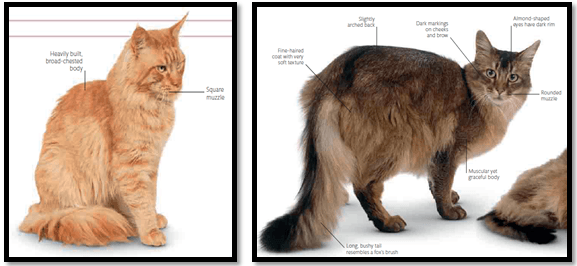
Maine coon (Left) and Somali (Right) cats (Complete and Breed, 2014).
Cats that have blood type A naturally have low anti-B antibody titers. The antigens of blood groups A and B are 2 gangliosides, which differ in the presence of N-acetylneuraminic acid (NeuAc) and N-glycyl-neuraminic acid (NeuGc). Blood type A cats express only NeuGc, and in contrast, type-B determinants are exclusively composed of NeuAc ( Barrot et al., 2017 ).
Type AB has the same amount of both NeuAc and NeuGc. Blood types A and B are inherited as a simple mendelian autosomal trait, with blood type A being dominant over B. Type AB is inherited as a third allele that is recessive to A and dominant to B. The AB blood type system is well described and is the first blood type, outside of primates and humans for which the gene has been identified (Barrot et al., 2017).
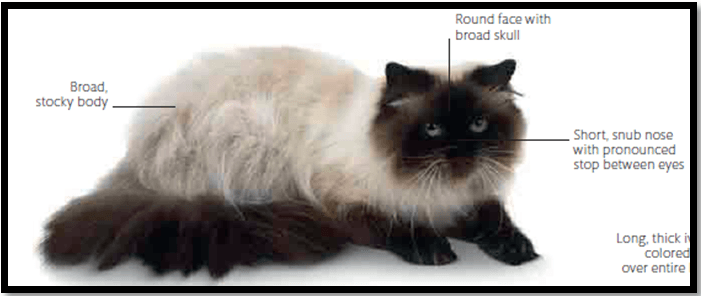
Himalayan Cat (Complete and Breed, 2014).
High titers of naturally occurring anti-A alloantibodies in cats with type B blood, result in rapid intravascular destruction of transfused type A red blood cells. Fatal hemolytic transfusion reactions have been documented in blood type B cats that received as little as 1 mL of blood from blood type A cats. This process is mediated by IgM and the complement cascade. Hemolysis of type B blood cells transfused to blood type A cats is mostly an extravascular process mediated by IgG and IgM without complement activation, the transfusion reaction in this case did not cause significant effects (Barrot et al., 2017).
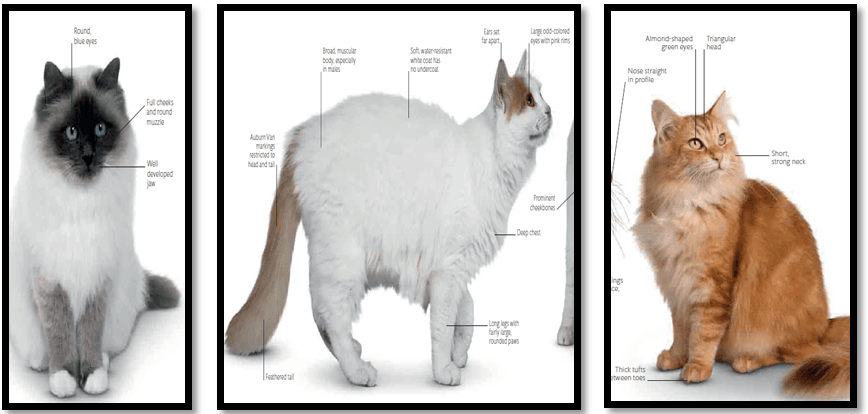
Burmese, Turkish Van and Norwegian forest cats (from left to right) (Complete and Breed, 2014).
HOW TO DETECT BLOOD GROUP IN CATS
Detection of cat blood groups can be carried out in commercial laboratories on whole blood samples with EDTA anti-coagulant or several methods can be used in clinical practice using card systems including RapidVet-H Feline, DMS Laboratories and paper strip cartridges such as DME VET A + B, Alvedia. The use of the card system depends on an agglutination reaction using anti-A antiserum to detect type A antigens and Triticum vulgaris lectin to detect type B antigens. Paper strip cartridges use monoclonal antibodies to differentiate blood groups and are able to differentiate rare blood types, namely AB (Barfield and Adamantos, 2011).

RapidVet-H Feline, blood type A (left) and blood type B (right) (Barfield and Adamantos, 2011).
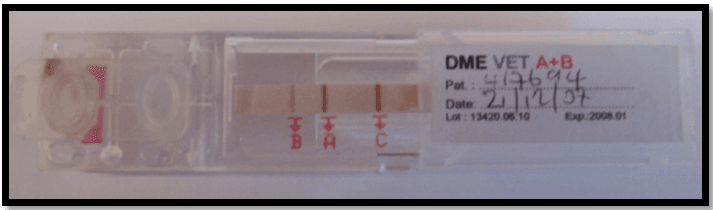
DME VET A+B, with AB blood group results (Barfield and Adamantos, 2011).
Apart from using a card system and paper strip cartridge, you can also detect blood type in cats using a gel tube typing kit. The cell suspension was incubated for 10 minutes, and centrifuged for 10 minutes in a centrifuge specially designed to hold the gel tube cartridge. The reaction is clearly visible as a dense to dispersed layer of agglutinating cells at or near the top of the gel column. Unreacted cells accumulate at the bottom of the column.
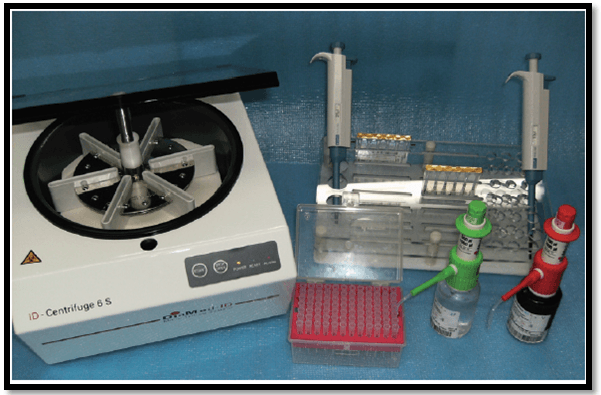
DME VET A+B, with AB blood group results (Barfield and Adamantos, 2011).
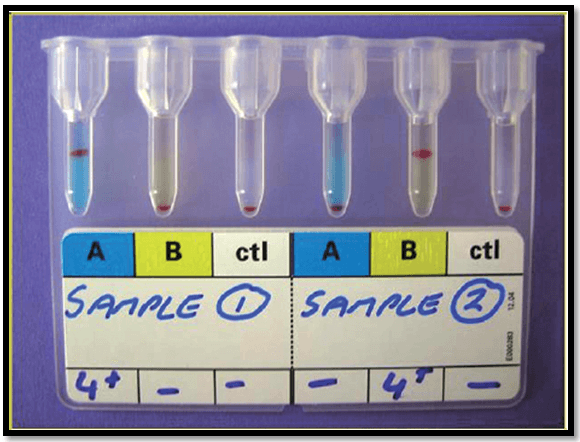
Gel tube typing kit shows blood type A (left) and blood type B (right) (Thrall et al., 2012).
Each microtube contains a gel matrix with anti-A monoclonal antibody in a tube labeled “A” and anti-B A in a tube labeled “B”; a tube labeled “clt” contains no reagent and serves as a negative control. Erythrocytes were separated from plasma by centrifugation at 3500 g for 10 minutes and 25 μl of sediment blood was diluted with 500 μl of low ionic strength solution. 12.5 μl RBC suspension of each sample was added to the set of 3 columns (A, B and ctl). The cartridge was centrifuged in an ID-Centrifuge at 910 g for 10 minutes (Proverbio et al, 2009).
In microtubes, red blood cells with surface antigen A bind the corresponding anti-A, and red blood cells with antigen B bind anti-B. When the result is positive all agglutinated red blood cells form lines on the surface of the gel (the greatest degree of agglutination, 4+) or agglutination dispersed in the gel (degree of agglutination from 3+ to 1+). If the result is negative (0), all the red blood cells are at the bottom of the tube. If both columns are positive, the cat has blood type AB. The column labeled CLT always has a negative reaction (Proverbio et al, 2009).
This method reportedly provides easier interpretation of results and higher accuracy for detecting blood types in cats. The card system, paper strip cartridge, and gel tube typing kit methods can provide inconclusive results in cats infected with Feline Leukemia Virus (FeLV). These three methods are accurate for detecting type B blood group, while the gel tube typing kit method is more accurate for detecting type AB blood group (Thrall et al., 2012).
BIBLIOGRAPHY
Barfield, D., & Adamantos, S. (2011). Feline blood transfusions. A pinker shade of pale. Journal of Feline Medicine and Surgery, 13(1), 11–23. https://doi.org/10.1016/j.jfms.2010.11.006
Barrot, A., Buttin, R., Linsart, A., Bachy, V., Guidetti, M., & Blais, M. (2017). Frequency of feline blood types in non-pedigree cats in France. Revue in Med Vet, 168(10–12), 235–240.
Khon, B., & Weingart, C. (2006). Feline Blood Typing and Transfusion - A Practical Approach. Feline Medicine, 351–353.
Proverbio, D., Spada, E., Baggiani, L., & Perego, R. (2009). Assessment of a gel column technique for feline blood typing. Veterinary Research Communications, 33(SUPPL. 1), 201–203. https://doi.org/10.1007/s11259-009-9275-7
Thrall, M. A., Weiser, G., Allison, R. W., & Campbell, T. W. (2012). Veterinary Hematology and Clinical Chemistry (Second Edi). United States: Wiley-Blackwell.