
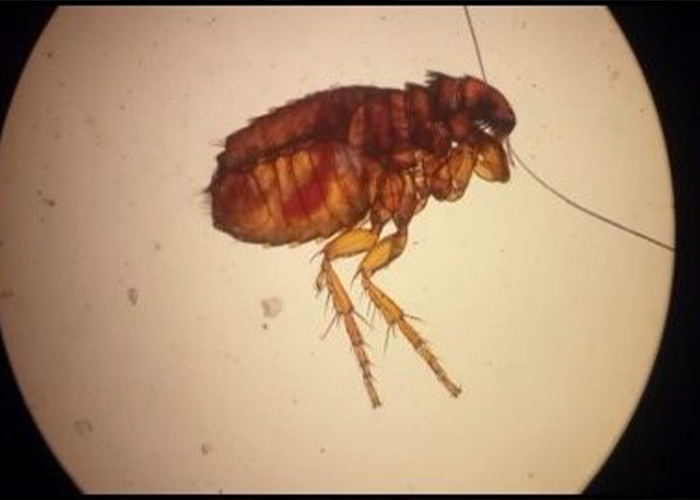
Hello pawmates, this time we want to share information about fleas, come on, pawmates, take a look at our article.
Learn about Ctenocephalides canis and Ctenocephalides felis in dogs and cats
Dogs and cats are domesticated animals that are very close to humans. Parasitic diseases are the most common problems found in dogs and cats. This disease is caused by parasites, both ectoparasites and endoparasites. Parasitic diseases can cause direct interference by parasites, infections, and secondary infections (bacteria, viruses, other parasites). Parasitic life is normal life either temporarily or permanently, but requires the presence of other organisms that provide food and/or a place for the parasite to live. The feeding organisms can be animals or plants and the presence of these parasites results in harm to the organisms they host. So the parasite lives on the hard work of other organisms, including our beloved animals (dogs and cats).
Ctenocephalides felis and Ctenocephalides canis (fleas)
Ctenocephalides felis and Ctenocephalides canis "Fleas" are insects belonging to the Class Insecta, order Siphonaptera and family Pulicidae, fleas have a flat body, without wings and are small. The mouth part corresponds to its function of tearing and sucking, the hind legs are well developed adapted to their function of jumping. Fleas undergo complete metamorphosis, fleas are not permanent parasites like lice and ticks, and often leave one host for another species. Fleas are most often found in cats and dogs. The life cycle can take 3 weeks. In the host's body there can be clinical symptoms such as irritation of the animal's body through bites, scratching and can also cause anemia in very severe attacks. Some animals become sensitive to salivary secretions which produces an intense pruritic reaction (hypersensitivity due to flea bites or flea allergic dermatitis) (Ballweber, 2001).
Cat fleas (Ctenocephalides felis) are close relatives of dog fleas (Ctenocephalides canis) can be found in cats and dogs. Both will serve as intermediate hosts for the tapeworm Dipylidium caninum. This tapeworm infection is often recognized by the presence of tapeworm proglottids (often referred to as “segments”), which look like grains of rice, in dog or cat feces. Humans are sometimes infected with this tapeworm; children are more likely to be infected because they are more likely to ingest fleas containing immature stages of the tapeworm (called cysticercoid), (Foreyt, 2001).
Ctenocephalides life cycle
• adult fleas remain on the dog or cat host, feeding and producing eggs.
• Eggs fall from the host and hatch in 2 to 5 days.
• Larvae feed on adult flea feces that fall from the host and organic debris in the environment
• Larvae develop into pupae, inside fibrous cocoons like silk (cross section)
• Adult fleas emerge from the cocoons in search of food (blood), (Ballweber, 2001).
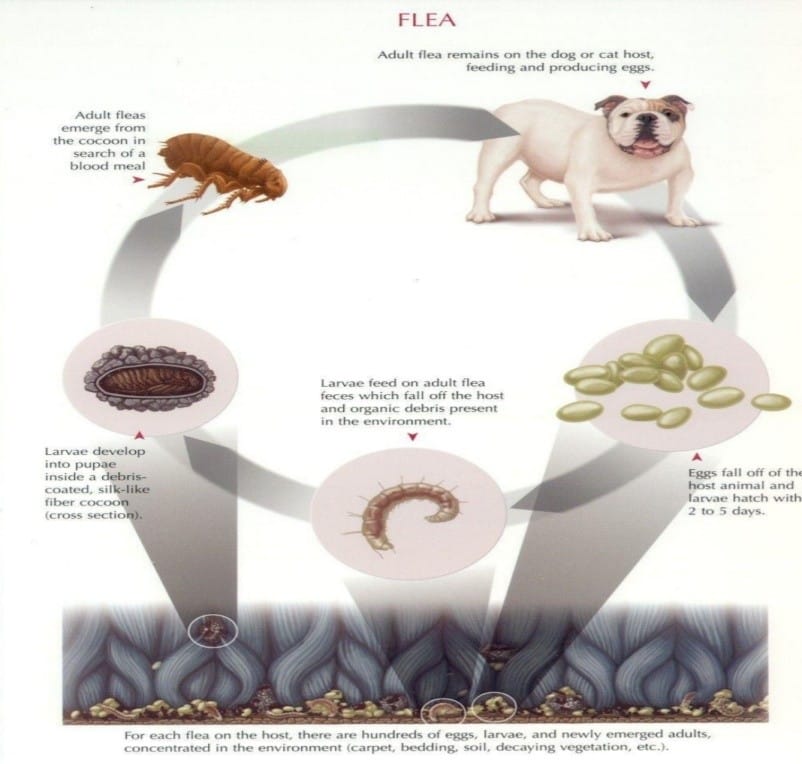
Source: Pfizer Atlas of Veterinary Clinical Parasitology
Female Ctenocephalides felis, the most common cat flea found on dogs, and Ctenocephalides felis are difficult to distinguish from Ctenocephalides canis itself. A characteristic that helps in identifying this genus is the pronotal comb. (Zajac and Conboy 2012)
K and P Clinic personal documents
The process of allergic dermatitis caused by fleas
• Normal skin
• when a flea bites, it will inject a large amount of saliva into the skin and will cause an inflammatory reaction.
• in animals that are allergic to flea saliva, the reaction is more pronounced, causing itching, scratching and can cause increased inflammation and ultimately hair loss.
• bacterial infections are a common sequelae of skin trauma caused by scratching, (Foreyt, 2001)
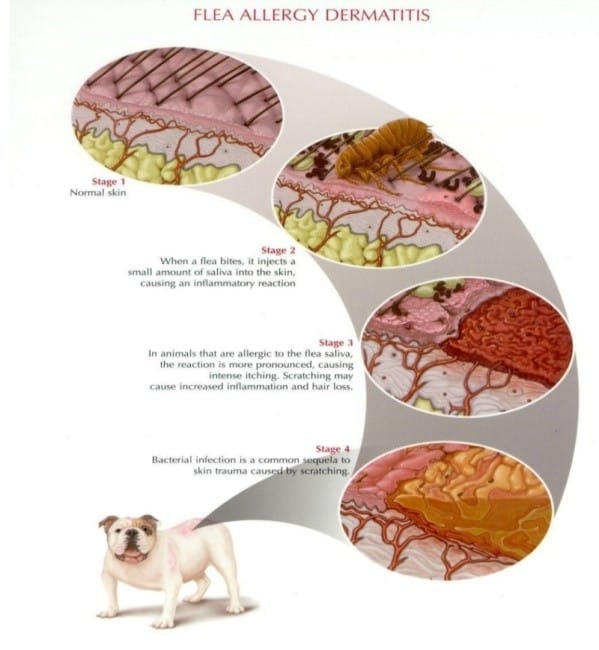
Source: Pfizer Atlas of Veterinary Clinical Parasitology
According to Gillespie and Pearson 2001, states that all fleas are blood eaters/suckers and in appropriate environmental conditions and frequent blood sucking, adults can live for several months. If they don't suck blood, fleas can live a short life.
Fleas are carriers of infectious diseases in humans. Xenopsylla cheopis as the vector of Pasteurella pestis causes bubonic plaque in most parts of the world, other fleas including dog and cat fleas have been shown to transfer plaque experimentally, but are not very important in natural conditions. (Bowman, Fogarty and Barr 2002).
Because of their painful bites and blood-sucking habit, fleas are very painful parasites so that cats and dogs have a very difficult rest, and reduce their body condition. Furthermore, dogs and cats can be sensitive to fleas and it is called summer eczema, often caused by flea infestation. Flea bites cause pain in the skin resulting in rubbing and biting of the host which results in Dermatitis Traumatica. (Gillespie and Pearson 2001).
BIBLIOGRAPHY
Ballweber, L, R, 2001., The practical Veterinary, Veterinary Parasitology, Butterworth–Heinemann supports the efforts of American Forests and the Global ReLeaf program in its campaign for the betterment of trees, forests, and our environment.
Blagburn, B, L, and Dryden M, W, 2012., Pfizer Atlas of Veterinary Clinical Parasitology, college of veterinary medicine Auburn Univ. and kansan state university.
Bowman, D, D. Fogarty E, A. and Barr, S, C 2002., Parasitology diagnosis and treatment of common parasitisms in dogs and cats.
Gillespie, S, H, and Pearson R, D, 2001., Principles and practice of clinical parasitology, John Wiley & Sons Ltd.
Zajac A. M. and Conboy G. A. 2012, Veterinary Clnical Parasitology, 8th Edition, Under the auspices of the American Association of Veterinary Parasitologists.